Explain End to End Protocol With Tcp and Ip Examples
Some of the most important protocols are Transmission Control Protocol TCP and User Datagram ProtocolUDP. Data can be lost or duplicated and datagrams can arrive out of order.
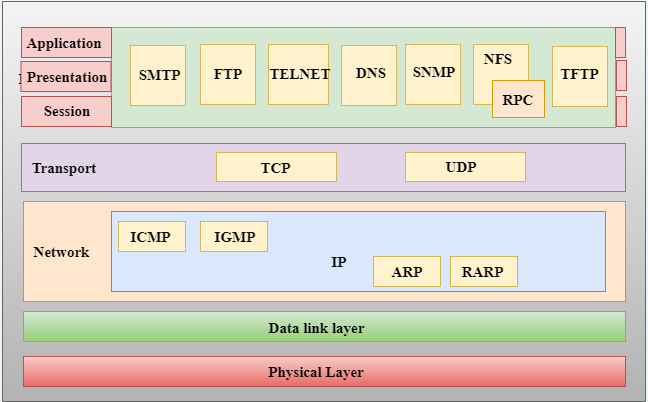
Computer Network Tcp Ip Model Javatpoint
TCP uses the acknowledge mechanism to check the safe and sound arrival of data performs multiplexing at the sender side and demultiplexes at the receiver end.
. The UDP protocol packet is called a. TCP provides end-to-end communication. It provides a datagram service between applications supporting both TCP and UDP.
Although the information is conceptual you should learn the names of the protocols. Gain an understanding of the layers and. The illustration below shows that the TCPIP suite also called the TCPIP stack appears in the Network Layer of the OSI Models protocol stack.
There is no end-to-end connection. An example of the end-to-end principle is that of an arbitrarily reliable file transfer between two endpoints in a distributed network of a varying nontrivial size. A network layer is the lowest layer of the TCPIP model.
Referring to the ISOOSI model end-to-end protocols work on the Transport Layer Layer 4 ie. IP works in conjunction with a protocol called TCP Transmission Control Protocol which ensures reliable end-to-end delivery of messages. Internet Protocol IP In terms of the OSI model IP is a network-layer protocol.
Introducing the TCPIP Protocol Suite. Data transmissions follow established protocols. UDP is a transport-level end-to-end protocol that adds addresses of transport-level control of errors in the checksum and data lengths from the top laying.
To understand the working of the networking protocol let us look at an example of a simple delivery. The TCPIP transport layer protocols ensure that packets arrive in sequence and without error by swapping acknowledgments of data reception and retransmitting lost packets. Its purpose is to deliver packets of data that consist of a header which contains routing information such as source and destination of the data and the data payload itself.
TCP ensures that the data reaches intended destination in the same order it was sent. IP address to IP address via router. To send a delivery from one place to another certain tasks are involved.
This protocol is used with an IP protocol so together they are referred to as a TCPIP. Two protocols display the transport layer. It is assigned to.
TCP uses three phases to achieve the connection orientation feature like connection establishment data transfer and connection termination. In such a setting lesser checksum and acknowledgement ACKNACK. Most Common TCPIP Protocols.
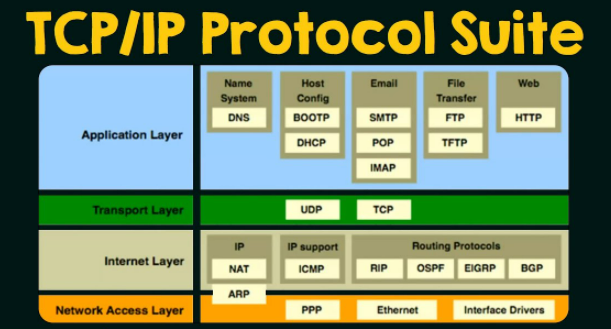
This layer handles end-to-end communication between devices on a network s the method for the connection TCP or UDP is decided on this level and the data being transmitted is segmented into packets and sent along to the network layer. Some of the Responsibilities of Transport Layer are as Follows. FTP SSH Telnet HTTP HTTPS DNS SMTP and POP3.
Transmission Control Protocol is an internet protocol suite which breaks up the message into TCP Segments and reassembling them at the receiving side. TCPIP is a hierarchical protocol made up of interactive modules and each of them provides specific functionality. Some widely used most common TCPIP protocol are.
TCP requires that connection between two remote points be established before sending actual data. Here hierarchical means that each upper-layer protocol is supported by two or more lower-level protocols. The network layer handles network to network communication.
This concept of TCPIP is not just important for people in the computer or IT fields but also is an. It does two types of Transmission ie Connection-Oriented Transmission and Connectionless Transmission which are carried out by TCP and UDP respectively. TCPIP is a layered protocol widely used in networking.
This section presents an in-depth introduction to the protocols that are included in TCPIP. For example IP is a low-level internet protocol that facilitates data communications over the internet. TCP protocol used almost anything where you have to get all transmitted data.
The main functionality of the TCP is to take the data from the application layer. It is a concise version of the OSI Model and comprises four layers in its structure. The Internet uses a protocol named IP Internet Protocol that distributes traffic from one network to another using a number of public routers and servers.
This model acts as a communication protocol for computer networks and connects hosts on the Internet. The service provides no guarantees. Few Very common protocols that use TCP are.
The full form of UDP is User Datagram Protocol. An end-to-end protocol is responsible for delivering messages to one or multiple network endpoints. There are numerous differences between TCPIP and IP.
The TCPIP model consists of several types of protocols including TCP and IP Address Resolution Protocol ARP Internet Control Message Protocol ICMP Reverse Address Resolution Protocol RARP and User Datagram Protocol UDP. It is a connectionless protocol. IMHO the end-to-end principle basically is about the communication between two or more processes in the network.
Functions of TCPIP layers. TCP provides flow control and quality of service. MTU of directly connected network size of TCP and IP headers.
TCP is the most commonly used of these protocols and accounts for the most traffic used on a TCPIP network. End-to-end Service Model Protocol Examples User Datagram Protocol UDP Transmission Control Protocol TCP End-to-End Service Model User perspective of network. Data is transmitted link by link.
TCP provides error-checking and recovery mechanism. An Internet Protocol address that is also known as an IP address is a numerical label. When people refer to TCPIP remember that they are talking about a suite of protocols and not just one protocol like most people think.
At first the package should be packed and addressed. End to End delivery. This type of communication is known as end-to-end Transport layer protocols at this level are Transmission Control Protocol TCP and User Datagram Protocol UDP.
The TCPIP model is a part of the Internet Protocol Suite. Learn how to identify verify and adjust layer 2 paths by using the Spanning Tree Protocol STP and how to correctly predict MAC addresses and IP addresses in a frame and packet. The only way two endpoints can obtain a completely reliable transfer is by transmitting and acknowledging a checksum for the entire data stream.
TCPIP is the acronym that is commonly used for the set of network protocols. Then it divides the data into a several packets provides numbering to these packets and. Because of this all network applications can be written to easily interface with the TCPIP protocols without regard to a particular network software manufacturer or medium.
Join Keith Barker as he teaches you about end-to-end IP communications and the forwarding methods used by layer 2 switches and layer 3 routers. TCP is connection oriented. You should also learn what each protocol does.
The Tcp Ip Reference Model And Protocol Suite Explained Infospark In

What Is Transmission Control Protocol Tcp Ip Model
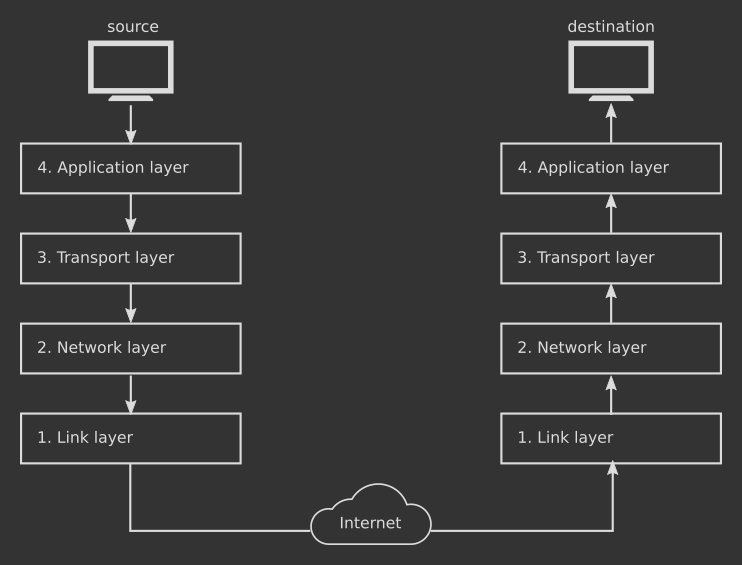
Introduction To The Tcp Ip Protocol Internal Pointers


Comments
Post a Comment